

Clinical pharmacology


BRILINTA pharmacology is different than that of thienopyridines1
BRILINTA belongs to a different chemical class than other oral antiplatelets (OAPs) and has different pharmacological properties1
The first and only OAP in a chemical class called cyclo-pentyl-triazolo-pyrimidine (CPTP)1
The first and only OAP in a chemical class called cyclo-pentyl-triazolo-pyrimidine (CPTP)1
Reversibly interacts with the P2Y12 receptor
Active without metabolism
Metabolism independent of CYP2C19 genotype
Primary CYP enzyme for metabolism
CPTP
BRILINTA2
Reversibly interacts with the P2Y12 receptorYes
Active without metabolismYes
Metabolism independent of CYP2C19 genotypeYes
Primary CYP enzyme for metabolism3A4
THIENOPYRIDINES
THIENOPYRIDINES
CLOPIDOGREL3
Reversibly interacts with the P2Y12 receptorNo
Active without metabolismNo
Metabolism independent of CYP2C19 genotypeNo
Primary CYP enzyme for metabolism2C19
THIENOPYRIDINES
PRASUGREL4
Reversibly interacts with the P2Y12 receptorNo
Active without metabolismNo
Metabolism independent of CYP2C19 genotypeYes
Primary CYP enzyme for metabolism3A4 and 2B6
- Ticagrelor and its active metabolite are approximately equipotent2
- It is not known how pharmacology or chemical class correlates to clinical efficacy or safety results
- There are no adequate, well-controlled, head-to-head clinical trials comparing BRILINTA and thienopyridines in patients with acute ischemic stroke or high-risk CAD without a history of MI or stroke
Pharmacokinetics2
Absorption
- Absorption of ticagrelor occurs with a median tmax of 1.5 hours (range 1.0-4.0). The formation of the major circulating metabolite AR-C124910XX (active) from ticagrelor occurs with a median tmax of 2.5 hours (range 1.5-5.0)
- The mean absolute bioavailability of ticagrelor is about 36% (range 30-42%). Ingestion of a high-fat meal had no effect on ticagrelor Cmax, but resulted in a 21% increase in AUC. The Cmax of its major metabolite was decreased by 22% with no change in AUC. BRILINTA can be taken with or without food
- BRILINTA as crushed tablets mixed in water, given orally or administered through a nasogastric tube into the stomach, is bioequivalent to whole tablets (AUC and Cmax within 80-125% for ticagrelor and AR-C124910XX) with a median tmax of 1.0 hour (range 1.0-4.0) for ticagrelor and 2.0 hours (range 1.0-8.0) for AR-C124910XX
Distribution
- The steady-state volume of distribution of ticagrelor is 88 L. Ticagrelor and the active metabolite are extensively bound to human plasma proteins (>99%)
Metabolism
- CYP3A4 is the major enzyme responsible for ticagrelor metabolism and the formation of its major active metabolite. Ticagrelor and its major active metabolite are weak P-glycoprotein substrates and inhibitors. The systemic exposure to the active metabolite is approximately 30-40% of the exposure of ticagrelor
Excretion
- The primary route of ticagrelor elimination is hepatic metabolism
- The primary route of elimination for the major metabolite of ticagrelor is most likely to be biliary secretion
- The mean t1/2 is approximately 7 hours for ticagrelor and 9 hours for the active metabolite
Pharmacodynamics
BRILINTA provided rapid onset and high inhibition of platelet aggregation (IPA) compared to clopidogrel5,6
Assessment of IPA over 8 hours after 180-mg loading dose2,6
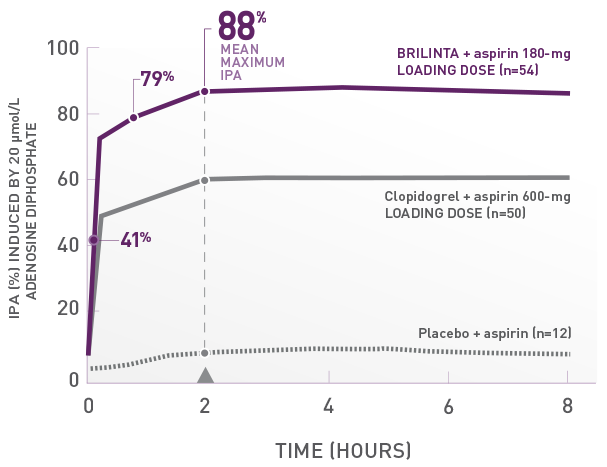
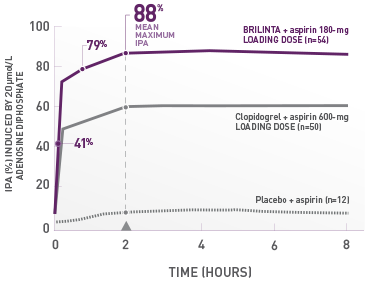
In a multicenter, randomized, double-blind study, patients with stable coronary artery disease (CAD) who were taking aspirin therapy (75 mg to 100 mg per day) received BRILINTA (180-mg loading dose, 90-mg twice-daily maintenance dose), clopidogrel (600-mg loading dose, 75-mg once-daily maintenance dose), or placebo for 6 weeks.5
- It is not known how bleeding or thrombotic risk tracks with IPA for either BRILINTA or clopidogrel2
- The maximum IPA effect of BRILINTA was 88% at around 2 hours and was maintained for at least 8 hours2,5
- IPA was higher in the BRILINTA group at all time points2
- Patients can be transitioned from clopidogrel to BRILINTA without interruption of antiplatelet effect2
- The transition from clopidogrel to BRILINTA resulted in an absolute IPA increase of 26.4%, and the transition from BRILINTA to clopidogrel resulted in an absolute IPA decrease of 24.5%2

Want to help your patients get started on BRILINTA?
References
- Husted S, van Giezen JJ. Ticagrelor: the first reversibly binding oral P2Y12 receptor antagonist. Cardiovasc Ther. 2009;27(4):259-274.
- BRILINTA® (ticagrelor) [package insert]. Wilmington, DE: AstraZeneca Pharmaceuticals LP; 2024.
- Plavix® (clopidogrel bisulfate) [package insert]. Bridgewater, NJ: Sanofi-Aventis U.S. LLC; 2022.
- Effient® (prasugrel) [package insert]. Indianapolis, IN: Eli Lilly and Company; 2019.
- Gurbel PA, Bliden KP, Butler K, et al. Randomized double-blind assessment of the ONSET and OFFSET of the antiplatelet effects of ticagrelor versus clopidogrel in patients with stable coronary artery disease: the ONSET/OFFSET study. Circulation. 2009;120(25):2577-2585.
- Data on File, REF-5072. AstraZeneca Pharmaceuticals LP.