THALES safety


Bleeding in the THALES trial
In patients with acute ischemic stroke (NIHSS ≤5) or high-risk TIA, Primary safety end point: GUSTO* severe bleeding event1,2
GUSTO severe bleeding
GUSTO severe bleeding
BRILINTA 90 mg + aspirin (N=5523) K-M%, n
K-M% n (0.5%) 280.5% 28
Placebo + aspirin (N=5493) K-M%, n
K-M% n(0.1%) 7 0.1% 7
AT 30 DAYS
AT 30 DAYSHR: 3.99 95% CI: 1.74-9.14 ARI: 0.4% NNH 2632
- Intracranial bleeding and fatal bleeding seen in THALES for BRILINTA + aspirin vs aspirin alone, respectively2:
- ICH: 21 vs 6
- Fatal bleeding: 11 vs 2
* GUSTO severe bleeding: Any one of the following: fatal bleeding, intracranial bleeding (excluding asymptomatic hemorrhagic transformations of ischemic brain infarctions and excluding microhemorrhages <10 mm evident only on gradient-echo magnetic resonance imaging), bleeding that caused hemodynamic compromise requiring intervention (eg, systolic blood pressure <90 mm Hg that required blood or fluid replacement, or vasopressor/inotropic support, or surgical intervention).2

Do you have questions about the THALES study?
IPSILATERAL ATHEROSCLEROTIC STENOSIS SUBGROUP
In patients with acute ischemic stroke (NIHSS ≤5) or high-risk TIA, Bleeding outcomes in patients with and without ipsilateral stenosis3
Patients with ipsilateral stenosis ≥30%
GUSTO severe bleeding
Fatal bleeding
ICH
Hemorrhagic stroke
BRILINTA 90 mg + Aspirin (N=1136)
Aspirin (N=1215)
No. of patients (%)
GUSTO severe bleeding4 (0.4%)
Fatal bleeding1 (0.1%)
ICH4 (0.4%)
Hemorrhagic stroke0 (0.0%)
Aspirin (N=1215)
No. of patients (%)
GUSTO severe bleeding3 (0.2%)
Fatal bleeding1 (0.1%)
ICH3 (0.2%)
Hemorrhagic stroke0 (0.0%)
Patients without ipsilateral stenosis ≥30%
GUSTO severe bleeding
Fatal bleeding
ICH
Hemorrhagic stroke
BRILINTA 90 mg + Aspirin (N=4387)
Aspirin (N=4278)
No. of patients (%)
GUSTO severe bleeding24 (0.5%)
Fatal bleeding10 (0.2%)
ICH16 (0.4%)
Hemorrhagic stroke10 (0.2%)
Aspirin (N=4278)
No. of patients (%)
GUSTO severe bleeding4 (0.1%)
Fatal bleeding1 (0.0%)
ICH3 (0.1%)
Hemorrhagic stroke2 (0.0%)
NNH for patients without ipsilateral atherosclerosis is 2503*
* GUSTO severe bleeding: Any one of the following: fatal bleeding, intracranial bleeding (excluding asymptomatic hemorrhagic transformations of ischemic brain infarctions and excluding microhemorrhages <10 mm evident only on gradient-echo magnetic resonance imaging), bleeding that caused hemodynamic compromise requiring intervention (eg, systolic blood pressure <90 mm Hg that required blood or fluid replacement, or vasopressor/inotropic support, or surgical intervention).2
FROM THE PRESPECIFIED IPSILATERAL ATHEROSCLEROSIS SUBGROUP ANALYSIS

For every 34 patients with ipsilateral atherosclerosis (≥30%) treated with BRILINTA 90 mg plus aspirin instead of aspirin, 1 additional event of stroke or death was prevented...
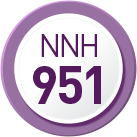
...and for every 951 patients with ipsilateral atherosclerosis (≥30%), 1 additional GUSTO severe bleeding event occurred.3,4†
*NNH was calculated using 1/ARI of BRILINTA + aspirin compared to aspirin alone (0.4%).3
†Calculation of NNH is based off of 1/ARI (1/[0.352%-0.247%]).3
THALES was not designed or powered to demonstrate the efficacy or safety of BRILINTA compared with placebo in specific subgroups. Subgroup analyses were performed to evaluate consistency of results in different cohorts. Analyses must be interpreted cautiously, as differences can reflect the play of chance among a large number of analyses.2
Do you have questions about the THALES study?
THALES STUDY DESIGN
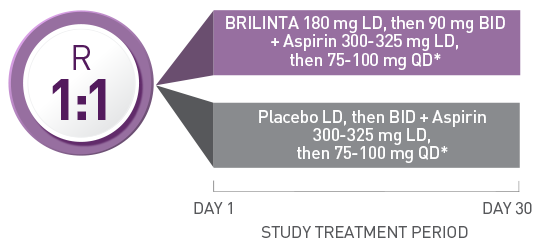
THALES was a randomized, international, double-blind, placebo-controlled, multicenter study to investigate dual antiplatelet therapy with BRILINTA (180-mg loading dose, 90 mg twice daily thereafter) and aspirin vs placebo and aspirin in the prevention of stroke or death in patients with acute ischemic stroke or transient ischemic attack (N=11,016). The primary end point was the first occurrence of the composite of stroke or death at 30 days. In both arms, patients received a loading dose of aspirin 300-325 mg followed by aspirin 75-100 mg once daily. Patients were ≥40 years of age, had mild-to-moderate acute noncardioembolic ischemic stroke (NIHSS score ≤5), or high-risk TIA (ABCD2 score ≥6 or symptomatic intracranial or extracranial arterial stenosis [≥50% narrowing in the diameter of the lumen of an artery that could account for the TIA]). Patients were randomized within 24 hours and treated for a median of 31 days.1,2
ABCD2=Age, Blood pressure, Clinical features, Duration of TIA, and Diabetes mellitus; ARI=absolute risk increase; CI=confidence interval; CV=cardiovascular; GUSTO=Global Use of Strategies to Open Occluded Coronary Arteries; HR=hazard ratio; ICH=intracranial hemorrhage; K-M=Kaplan-Meier; NIHSS=National Institutes of Health Stroke Scale; NNH=number needed to harm; NNT=number needed to treat; THALES=Acute STroke or Transient IscHemic Attack Treated with TicAgreLor and Aspirin for PrEvention of Stroke and Death; TIA=transient ischemic attack.
References
- BRILINTA® (ticagrelor) [package insert]. Wilmington, DE: AstraZeneca Pharmaceuticals LP; 2024.
- Johnston SC, Amarenco P, Denison H, et al; THALES Investigators. Ticagrelor and aspirin or aspirin alone in acute ischemic stroke or TIA. N Engl J Med. 2020;383(3):207-217 and Supplementary Appendix.
- Amarenco P, Denison H, Evans SR, et al. Ticagrelor added to aspirin in acute nonsevere ischemic stroke or transient ischemic attack of atherosclerotic origin. Stroke. 2020;51(12):3504-3513.
- Data on File, REF-51076, AstraZeneca Pharmaceuticals LP.
THE THALES STUDY1
11,016 patients were randomized within 24 hours and treated for 30 days1
OBJECTIVE
THALES compared dual antiplatelet therapy (DAPT) with BRILINTA 90 mg and aspirin vs placebo and aspirin in patients with acute ischemic stroke or high-risk TIA for the primary efficacy end point of the composite of stroke or death and the primary safety end point of first GUSTO severe bleeding.
STUDY DESIGN
Randomized, double-blind, placebo-controlled, parallel-group, multicenter trial conducted across 28 countries and 414 sites
Primary efficacy composite end point: Stroke (ischemic and hemorrhagic) or all-cause death
Key secondary efficacy end point: Ischemic stroke
Primary safety end point: GUSTO severe bleeding
Key inclusion criteria
- Patients ≥40 years of age, randomized within 24 hours after onset of symptoms, with:
- Mild-to-moderate acute noncardioembolic ischemic stroke (NIHSS score ≤5 and persistent signs or symptoms at the time of randomization or acute ischemic brain lesion determined by CT scan or MRI)
OR
- High-risk TIA (ABCD2 score ≥6 or with large-vessel disease [ie, ipsilateral ≥50% stenosis of extra- or intracranial artery])
Key exclusion criteria
- Thrombolysis or mechanical thrombectomy within 24 hours before randomization
- Planned use of anticoagulation
- Planned use of antiplatelet therapy other than aspirin
- History of atrial fibrillation/flutter or ventricular aneurysm
- Suspicion of a cardioembolic cause of TIA or stroke
- History of ICH or GI bleeding within the past 6 months or major surgery within 30 days
*Loading doses were given to patients as soon as possible after randomization on day 1.
ABCD2=Age, Blood pressure, Clinical features, Duration of TIA, and Diabetes mellitus; BID=twice daily; CT=computed tomography; GI=gastrointestinal; GUSTO=Global Use of Strategies to Open Occluded Coronary Arteries; ICH=intracranial hemorrhage; LD=loading dose; MRI=magnetic resonance imaging; NIHSS=National Institutes of Health Stroke Scale; QD=once daily; THALES=Acute STroke or Transient IscHemic Attack Treated with TicAgreLor and Aspirin for PrEvention of Stroke and Death; TIA=transient ischemic attack.
Reference: 1. Johnston SC, Amarenco P, Denison H, et al; THALES Investigators. Ticagrelor and aspirin or aspirin alone in acute ischemic stroke or TIA. N Engl J Med. 2020;383(3):207-217, Supplementary Appendix, and Protocol.