Patient education about ACS/Prior MI


Help protect against another heart attack
After a heart attack, your risk for another one remains increased, permanently.1
A heart attack is also called acute coronary syndrome or ACS.

Up to 1 in 5 patients is at risk for a recurrent CV event or death1,2*†
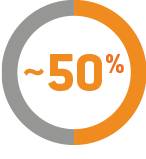
If you had a stent put in, your risk is still high. Nearly half of second heart attacks occur at another location in the arteries of your heart—not where you had your stent put in3‡
Key risk factors for another heart attack4
 Patient age
 Medical history
 Health conditions
 Severity of heart attack
Do everything you can to help reduce your risk, including taking medicines as prescribed by your cardiologist.
*The APOLLO HELICON analysis was a retrospective cohort study that included 108,315 patients from a National Swedish registry with a primary diagnosis of acute MI between July 2006 and June 2011. The primary end point was risk of nonfatal MI, nonfatal stroke, or CV death. The cumulative 1-year incidence of the primary end point was 18.3%.1
†Data from 6 pooled cardiovascular registries of the National Heart, Lung, and Blood Institute: the Framingham Heart Study, the Atherosclerosis Risk in Communities, the Cardiovascular Health Study, Multi-Ethnic Study of Atherosclerosis, Coronary Artery Risk Development in Young Adults, and Jackson Heart Study in patients ≥45 years of age, after their first MI from 1995-2012. Incidence in different populations may be higher or lower. From the American Heart Association (AHA) Heart Disease and Stroke Statistics 2022 Update, a publication of statistics on heart disease, stroke, other vascular diseases, and their risk factors from the AHA, Centers for Disease Control and Prevention (CDC), National Institutes of Health (NIH), and other government agencies.2
‡The Providing Regional Observations to Study Predictors of Events in the Coronary Tree (PROSPECT) study was conducted at 37 sites in the United States and Europe. 697 patients with ACS underwent 3-vessel coronary angiography and grayscale and radiofrequency intravascular ultrasonographic imaging after PCI. Median follow-up was 3.4 years, and 96% of patients underwent stent implantation. Subsequent major adverse CV events (death from cardiac causes, cardiac arrest, MI, or rehospitalization due to unstable or progressive angina) were adjudicated to be related to either originally treated (culprit) lesions or untreated (nonculprit) lesions.3

Want to help your patients get started on BRILINTA?
Risk after a heart attack is high.
REAL-WORLD DATA FROM ACTION REGISTRY-GWTG (Get With the Guidelines)*
Two-year rate: Death, MI, or stroke in patients with STEMI vs NSTEMI4

Whether you had a heart attack classified as STEMI or NSTEMI, you are at high risk of having another one
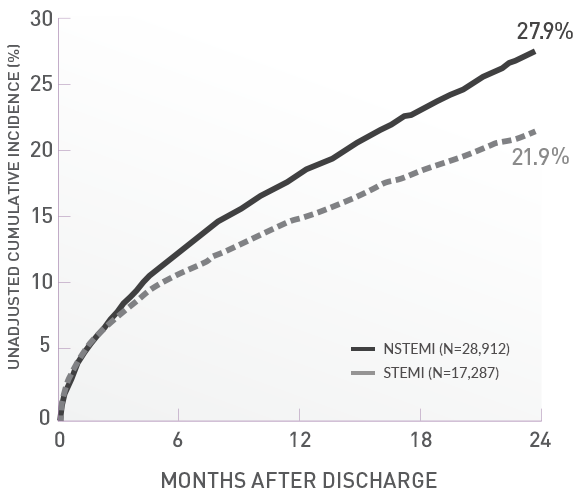
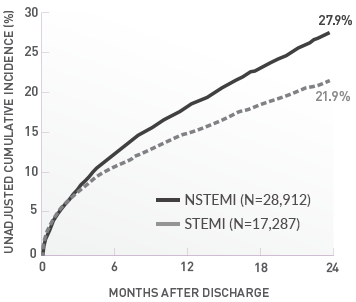
- Cumulative incidence of death, MI, or stroke in STEMI vs NSTEMI: within the first 90 days: 7.9% vs 8.1%; 90 days to 2 years: 15.2% vs 21.5%; Post discharge to 2 years: 21.9% vs 27.9%.
*The ACTION Registry–Get With the Guidelines (GWTG) is the largest nationwide registry of acute MI in the United States. Patients (N=46,199) were ≥65 years, who presented with either STEMI or NSTEMI to 504 participating hospitals from January 2, 2007 to December 31, 2010, underwent coronary angiography, found to have significant CAD with at least one coronary stenosis in a major epicardial vessel >50%, and had been enrolled in Medicare fee-for-service Parts A and B plans for at least 1 year prior to the index MI hospitalization. Patients who survived the index hospitalization and were discharged to home were included. From hospital discharge through 2 years, the cumulative incidence rates for the composite end point were lower among patients with STEMI compared to those with NSTEMI.
Long-term risk one year after a heart attack
Once you’ve had a heart attack, you remain at risk for having another. Permanently.

If you have 2 or more risk factors, your risk is even higher. 3 out of 4 patients who had another heart attack had 2 or more risk factors5
Risk factors included5
- Chronic kidney disease (eGFR 15-89 mL/min/1.73 m2)
- Multivessel coronary artery disease
- Diabetes mellitus managed with antidiabetic medicine
- Age ≥65 years
- Anemia
- Chronic lung disease
- Prior MI (>3 months prior)
- Peripheral artery disease
- Left ventricular ejection fraction <40%
- Cardiac arrest or cardiogenic shock during MI hospitalization
Questions to review with your ACS patients
Review these important topics with patients taking BRILINTA.
- Do your patients understand their risk of having another heart attack?
- Do your patients understand why you've chosen their treatment regimen, including their oral antiplatelet?
- Are your patients aware of how to take their treatment regimen, including their oral antiplatelet?
- Do they understand how long they may need to take medications, including their oral antiplatelet, and potential reasons for discontinuation?
- Do they know that it’s important to stay on their treatments for as long as their doctor recommends?
- Are they aware of what lifestyle modifications they need to make, such as diet, exercise, cardiac rehabilitation, and management of comorbidities?
- Are your patients aware of the possible side effects of their medications, including their oral antiplatelet?
- Do your patients understand the importance of talking to other physicians about the medications they are taking, including their oral antiplatelet?
Want to help your patients get started on BRILINTA?
EXPLORE MORE
ACS=acute coronary syndrome; CAD=coronary artery disease; CV=cardiovascular; eGFR=estimated glomerular filtration rate; MI=myocardial infarction; NSTEMI=non–ST-elevation myocardial infarction; STEMI=ST-elevation myocardial infarction.
References
- Jernberg T, Hasvold P, Henriksson M, et al. Cardiovascular risk in post-myocardial infarction patients: nationwide real world data demonstrate the importance of a long-term perspective. Eur Heart J. 2015;36(19):1163-1170.
- Tsao CW, Aday AW, Almarzooq ZI, et al. Heart disease and stroke statistics-2022 update: a report from the American Heart Association. Circulation. 2022;145(8):e153-e639.
- Stone GW, Maehara A, Lansky AJ, et al; PROSPECT Investigators. A prospective natural-history study of coronary atherosclerosis. N Engl J Med. 2011;364(3):226-235.
- Vora AN, Wang TY, Hellkamp AS, et al. Differences in short- and long-term outcomes among older patients with ST-elevation versus non-ST-elevation myocardial infarction with angiographically proven coronary artery disease. Circ Cardiovasc Qual Outcomes. 2016;9(5):513-522.
- Spertus J, Bhandary D, Fonseca E, et al. Contemporary incidence of recurrent cardiovascular events 1 to 3 years after myocardial infarction: longitudinal US analysis from NCDR registries linked with all-payer claims database. Presented at: The American College of Cardiology 67th Annual Scientific Session & Expo; Orlando, FL; March 12, 2018.